

Our foreign language book recommendations for GCSE and A Level language students
At Blue Stamp Travel, we promote learning outside the classroom and believe immersing yourself in your target language in your daily life is the most effective ways to build confidence and fluency. One of the best ways to do this is by reading foreign language books!
Reading in your target language helps you recognise vocabulary in context, understand how sentences are structured, and become more comfortable with natural language patterns. Books also expose you to culture, colloquialisms and everyday situations that bring the language to life. Instead of memorising vocab lists, reading allows you to see how the language is used in real-life, making it easier to remember and reuse!
Why reading helps language learning
Reading regularly in your target language allows you to:
- Expand your vocabulary gradually and naturally through context
- Improve your understanding of grammar without relying solely on textbooks
- Retain information better than memorising lists
- Recognise common phrases and sentence structures
- Strengthen comprehension skills at your own pace
- Gain insight into culture, history and everyday life in French, German or Spanish-speaking countries
A key benefit of books is that you can go at your own speed. You can pause, reread sections, underline words, and revisit chapters as many times as you need, making them a great resource for independent learning.
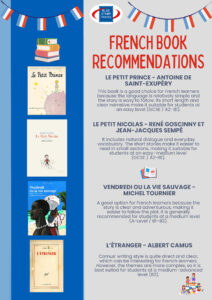
French book recommendations
Le Petit Prince – Antoine de Saint-Exupéry
Written and published in 1943, Le Petit Prince is a short philosophical story of around 96 pages and is famous around the world. The story follows a young prince who travels from planet to planet, meeting different characters who represent different aspects of human nature. When he arrives on Earth, he meets a pilot stranded in the desert, and their conversations explore themes such as friendship, imagination and what is truly important in life. This book is a good choice for French learners because the language is relatively simple and the story is easy to follow. Its short length and clear narrative make it suitable for students at an easy level (GCSE / A2–B1).
Le Petit Nicolas – René Goscinny et Jean-Jacques Sempé
Le Petit Nicolas is a collection of humorous stories of around 160 pages told from the perspective of a young schoolboy, written in 1959 and first published the same year. The book follows Nicolas and his friends as they get into trouble at school, play games and misunderstand the adult world around them. The stories are simple, funny and focus on everyday situations. It includes natural dialogue and everyday vocabulary. The short stories make it easier to read in small sections, making it suitable for students at an easy–medium level (GCSE / A2–B1).
Vendredi ou la vie sauvage – Michel Tournier
Written and published in 1971, Vendredi ou la vie sauvage is a novel of around 160 pages inspired by the story of Robinson Crusoe. It follows a man called Robinson who becomes stranded on a desert island after a shipwreck. During his time alone he learns to survive, and later meets another character called Vendredi, who changes the way he sees the world. A good option for French learners because the story is clear and adventurous, making it easier to follow the plot. It is generally recommended for students at a medium level (A-Level / B1–B2).
L’Étranger – Albert Camus
L’Étranger is a short novel of around 123 pages written and published in 1942, and is one of the most famous works of modern French literature. The story follows a man called Meursault who lives in Algeria and reacts in an unusual way to the events around him, including the death of his mother and a violent incident that leads to a major turning point in his life. Camus’ writing style is quite direct and clear, which can be interesting for French learners. However, the themes are more complex, so it is best suited for students at a medium–advanced level (B2).
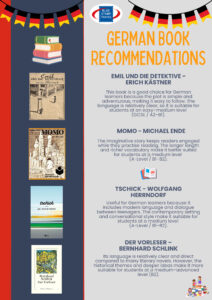
German
Emil und die Detektive – Erich Kästner
Written and published in 1929, Emil und die Detektive is a children’s novel of around 170 pages. The story follows a young boy called Emil who travels to Berlin to visit his grandmother. During the journey his money is stolen, and with the help of a group of local children he tries to track down the thief in the city. This book is a good choice for German learners because the plot is simple and adventurous, making it easy to follow. The language is relatively clear, so it is suitable for students at an easy–medium level (GCSE / A2–B1).
Momo – Michael Ende
Momo is a fantasy novel of around 304 pages written and published in 1973. The story follows a young girl called Momo who has a special ability to listen to people. When mysterious “grey men” begin stealing people’s time, Momo tries to stop them and help restore balance to the world. The imaginative story keeps readers engaged while they practise reading. The longer length and richer vocabulary make it better suited for students at a medium level (A-Level / B1–B2).
Tschick – Wolfgang Herrndorf
Tschick is a novel of around 253 pages written and published in 2010, about two teenagers who go on an unexpected road trip across Germany. The narrator, Maik, is a shy and unpopular boy at school who becomes friends with Tschick, a mysterious new student. Together they steal a car and travel through the countryside, meeting different people along the way. Useful for German learners because it includes modern language and dialogue between teenagers. The contemporary setting and conversational style make it suitable for students at a medium level (A-Level / B1–B2).
Der Vorleser – Bernhard Schlink
Der Vorleser is a novel of around 218 pages set in Germany after the Second World War, written and published in 1995. The story follows Michael, a teenage boy who develops a relationship with an older woman called Hanna. Years later, he discovers that she is on trial for crimes connected to the war, forcing him to confront difficult questions about guilt, responsibility and the past. Its language is relatively clear and direct compared to many literary novels. However, the historical themes and deeper ideas make it more suitable for students at a medium–advanced level (B2).
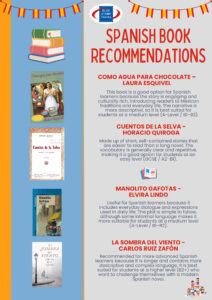
Spanish
Como agua para chocolate – Laura Esquivel
Written and published in 1989, Como agua para chocolate is a novel of around 246 pages set in Mexico during the early twentieth century. The story follows Tita, a young woman who is forbidden to marry because of a family tradition. Much of the story is told through food and cooking, with each chapter beginning with a traditional Mexican recipe that reflects the emotions and events of the characters’ lives. This book is a good option for Spanish learners because the story is engaging and culturally rich, introducing readers to Mexican traditions and everyday life. The narrative is more descriptive, so it is best suited for students at a medium level (A-Level / B1–B2).
Cuentos de la selva – Horacio Quiroga
Cuentos de la selva is a collection of short stories of around 100 pages set in the South American jungle, written and published in 1918. The stories mainly focus on animals such as turtles, parrots and jaguars, and often contain simple adventures or moral lessons. Quiroga was inspired by the natural environment of the Misiones jungle in Argentina, which plays an important role in the stories. Made up of short, self-contained stories that are easier to read than a long novel. The vocabulary is generally clear and repetitive, making it a good option for students at an easy level (GCSE / A2–B1).
Manolito Gafotas – Elvira Lindo
Written and published in 1994, Manolito Gafotas is a humorous novel of around 136 pages about a young boy growing up in a working-class neighbourhood of Madrid. The story is narrated by Manolito himself, who describes his everyday life, family and school experiences in a funny and honest way. The book became very popular in Spain and is part of a well-known series. This is useful for Spanish learners because it includes everyday dialogue and expressions used in daily life. The plot is simple to follow, although some informal language makes it more suitable for students at a medium level (A-Level / B1–B2).
La sombra del viento – Carlos Ruiz Zafón
La sombra del viento is a mystery novel of around 478 pages set in Barcelona after the Spanish Civil War, written and published in 2001. The story follows a young boy, Daniel, who discovers a forgotten book in a secret library called the “Cemetery of Forgotten Books”. As he tries to learn more about the mysterious author, he becomes involved in a dark story involving secrets, love and danger. We recommended this for more advanced Spanish learners because it is longer and contains more descriptive and complex language. It is best suited for students at a higher level (B2+) who want to challenge themselves with a modern Spanish novel.
How to make the most of reading in a foreign language
Incorporating books into your routine can significantly improve your language skills if approached actively rather than passively. Here are some practical tips to help you get the most out of your reading:
1. Start with the right level
Choose a book that matches your ability. If the text is too difficult, you may become frustrated. If it is too easy, you may not learn enough. Short stories or simplified classics are a great place to begin.
2. Read in short sections
Break the book into manageable chunks. Reading a few pages a day is more effective than trying to read large sections at once, especially when learning a new language.
3. Highlight and note new vocabulary
Keep a notebook or annotate your book by underlining new words and phrases. Look them up, write down their meanings, and revisit them regularly to reinforce your memory.
4. Re-read to reinforce understanding
Reading the same section more than once helps you notice vocabulary and grammar patterns you may have missed the first time. Repetition is key to retention.
5. Try reading aloud
Reading aloud can improve pronunciation and help you become more comfortable with the rhythm and flow of the language.
6. Focus on context, not every word
You don’t need to understand every single word. Try to grasp the overall meaning of sentences and paragraphs, and use context clues to infer unfamiliar vocabulary.
7. Make it part of your routine
Incorporate reading into your daily life. Whether it be before bed, during a commute, or while relaxing at home, being consistent will make develop your language skills over time.
Final thoughts
Whether you are learning French, German or Spanish, or another language altogether, reading books in your target language is a fun, relaxing and effective way to improve your skills. It helps you build vocabulary, understand grammar in context and develop a deeper connection with the language and culture.
Grab a book, take your time, and make language learning part of your everyday routine!