
School Trips | Spain
Cultural tours, language courses and unforgettable school trips to Spain

Discover Spain with Blue Stamp Travel
Blue Stamp Travel is one of the UK’s leading providers of bespoke school trip packages to Spain. Whether you’re looking for a short trip to Barcelona for your primary school group, or a fully immersive homestay work experience trip for your A-level Spanish class, tell us about your trip plans to request a comprehensive, competitive quote.
Cultural Tours to Spain
A school trip to Spain is always popular with learners of all ages. If you’re looking for inspiration, here’s a selection of our favourites, from big cities to smaller destinations.
City destinations in Spain
- Barcelona offers instant name recognition, buzz, energy and bucket-list sights. From theme parks to Gaudi, Barcelona has it all.
- Valencia captures the energy and style of its bigger Catalonian cousin, but without the crowds and long travel times. The City of Arts and Sciences is always a hit.
- Seville is full of cultural and artistic treasures, especially the great cathedral and Real Alcazar.
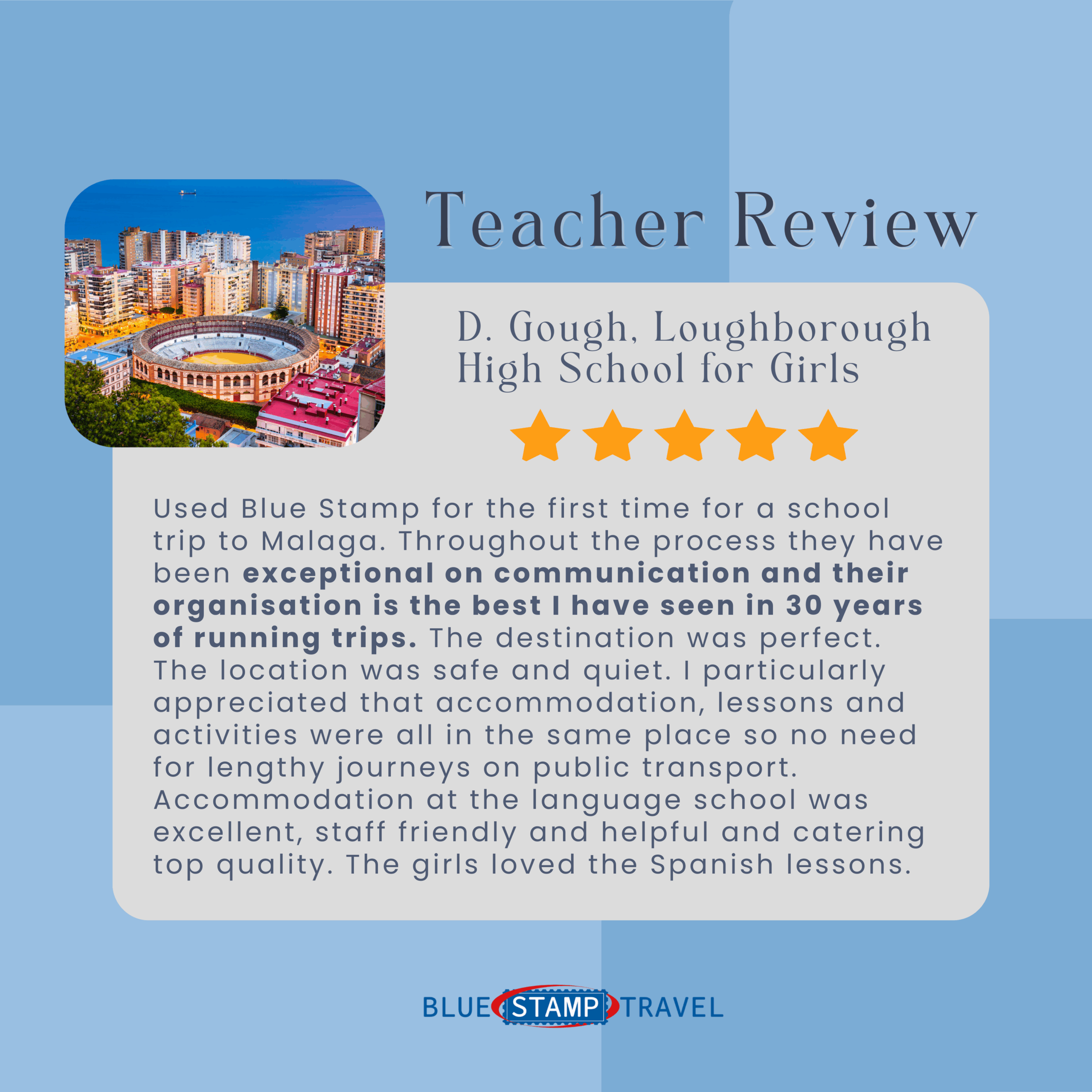
- Malaga has Moorish architecture, a fine cathedral and vibrant cultural life – often at competitive prices compared to more famous destinations
Smaller Spanish cities
- Granada boasts UNESCO world heritage sites and a rich cultural heritage, along with a modern science park. At 738m above sea level, it can be cooler than other cities.
- Alicante is a friendly, welcoming city that makes a great introduction to Spanish life and culture.
- Salamanca, rich in history and culture, compact and walkable, the ‘Golden City’ offers a very different experience of Spain to the tourist hotspots.
- Girona in Catalonia is an ancient settlement and important centre of Jewish culture and learning in Spain, and great for a day trip to Barcelona.
Trips for younger learners
Barcelona is always popular for Key Stage 2 and Key Stage 3 school trips to Spain, with its mix of cultural sights and excitement at theme parks such as PortAventura and Tibidabo.
Our Andalusia School Trip is based in Benalmadena, a charming small town just outside Malaga. The busy itinerary includes visiting a butterfly farm, riding a cable car, and a flamenco dance lesson, along with excursions to picturesque Ronda and Mijas. Ideal for a self-contained taster of Spanish life.
Group Language Courses in Spain
Adding language lessons to a school trip is a great way to enhance the educational value of a visit and increase buy-in from parents, EVCs and school leaders. We work with leading language schools across Spain which provide tailored programmes in closed groups for students of all ages, from absolute beginners to dedicated A-level preparation. See our list of Spanish Language Courses for Groups to explore the varied destinations, formats and activities available.



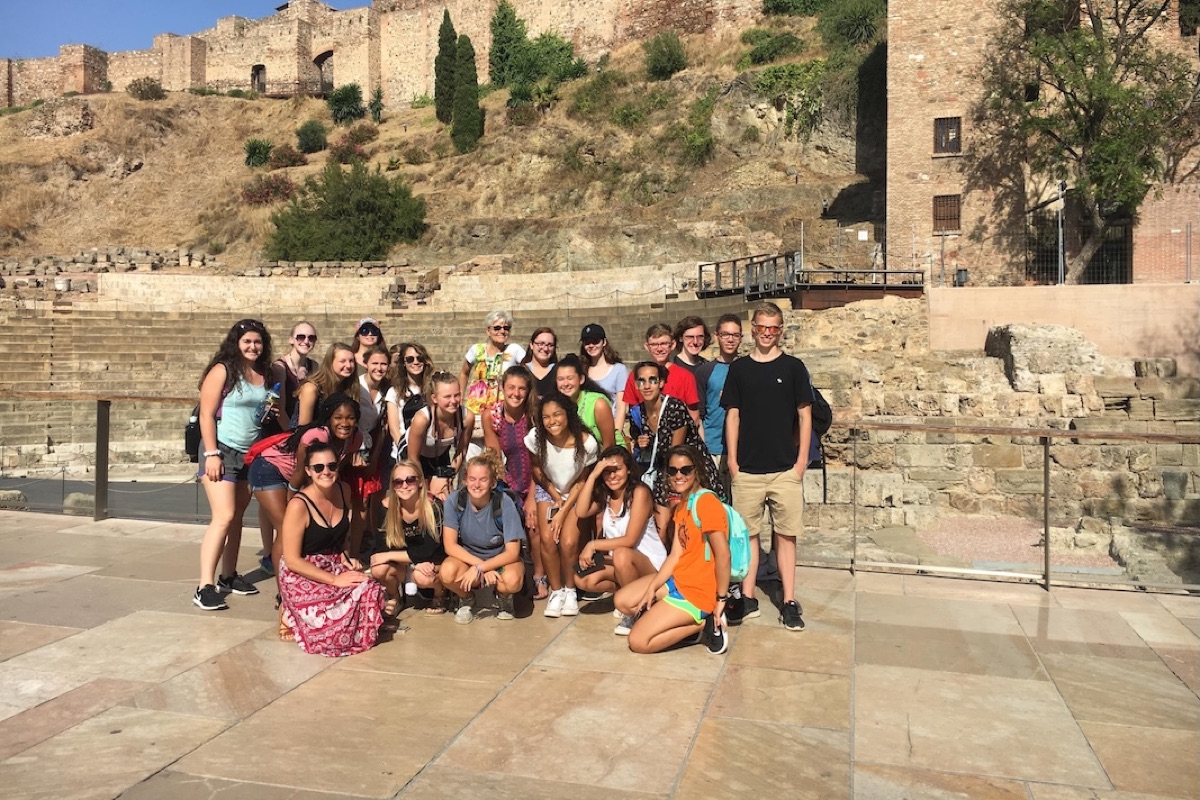
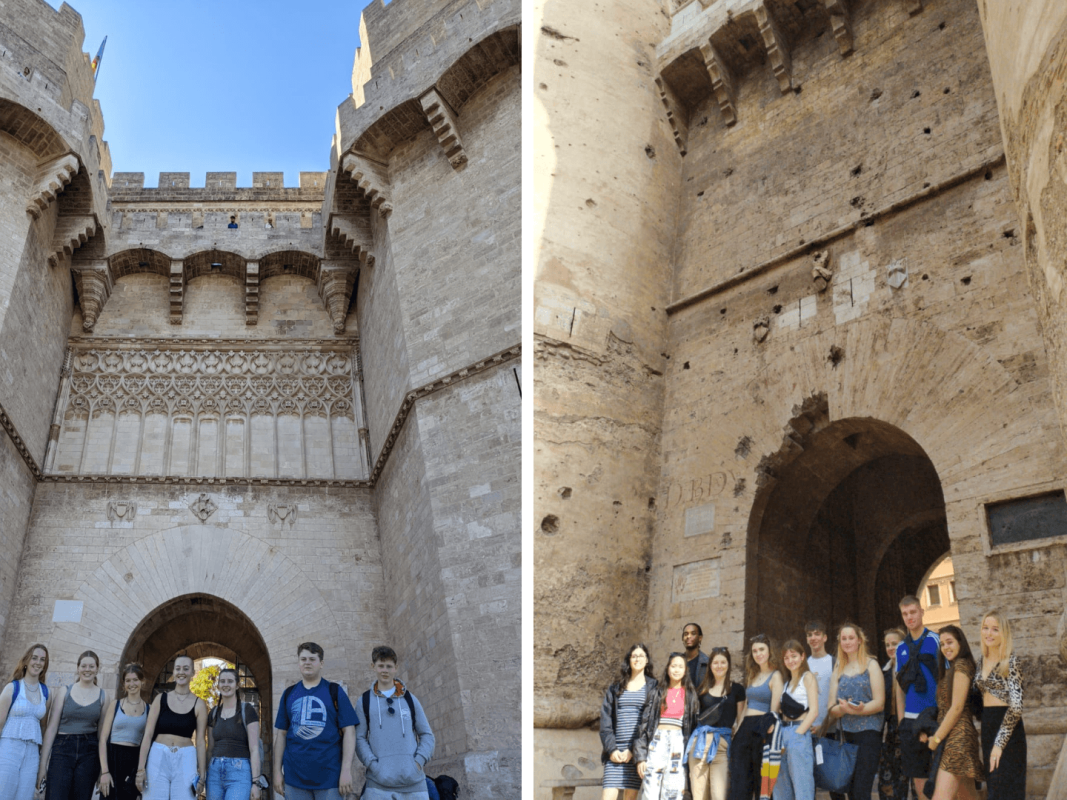
Explore School Trips to Spain
Filter Group Trips
Group Travel
When you request a quotation for your school trip, you can tell us your preferred mode of transport from the UK to your destination. Travelling by air is the most popular choice, but many groups also go by train, particularly for destinations accessible by Eurostar from St Pancras. Coach travel is a great option for larger groups.
When we quote for a trip, we commit to honest, transparent and fair pricing for your confidence and peace of mind.
We will be happy to include UK coach or public transport transfers in our quotation for your school trip. Just let us know.
When you request a quotation from us, tell us which airports are most convenient for your school. We will strike the best balance of flight availability, cost, arrival/departure times and UK transfer times, working with you to choose the option that suits you and your students.
If it is not possible to reach your chosen destination without long UK transfers, we will be happy to suggest alternative destinations to ensure your students have a memorable and rewarding experience abroad.
Your itinerary will always include transfers on arrival and departure from your destination country. Depending on your arrival time, group size, and accommodation type, the transfer could be by:
- public transport
- private coach
- host accommodation collection
Given the availability of sustainable, efficient and very affordable public transport in many of our destination cities, public transport is often the best way to get around, especially for smaller groups. However you make your way into your destination city, your Blue Stamp Travel itinerary will contain all the information you need to begin your trip with confidence.
At Blue Stamp Travel, we are committed to encouraging sustainable educational travel and will always offer groups the option to travel by public transport for activities and excursions in country. For students, travelling by public transport is a chance to experience an authentic experience of the destination.
We will arrange tickets for all excursions by public transport or provide clear instructions on how to purchase tickets if it is not possible to do so in advance. In all cases, your itinerary will reflect the size, stage and nature of your group.
During the trip preparation phase, we collect all your travellers’ passports through our Babel trip management platform, sparing you the stress of handling passports and online check-in for your group.
Trip organisers must ensure their travellers hold passports with sufficient validity for the whole of their trip – for trips to the EU, for example, passports must be valid for at least three months after the planned date of return to your country of origin.
We cannot provide legal advice on visa or passport validity and advise all travellers with questions to seek assistance from the relevant embassy or consulate.
The European Entry/Exit System (EES) is due to begin operation on 12 October 2025, rolled out in stages until April 2026. The new system will collect biometric data on travellers from outside the EU visiting for short stays of up to 90 days in a 180-day period.
Travellers will be able to register their details on arrival for the first time using self-service equipment. Some countries may provide a mobile app to allow travellers to record their details before travelling, which will speed up the process. Biometric passports will also reduce the volume of data to be collected on first arrival in the EU.
Blue Stamp Travel will advise you on the best way to manage your group’s EES requirements.
ETIAS is not expected to go into operation until late 2026.
Read our guide to EES and ETIAS to find out more. The official EU EES website contains much useful information and FAQs, and the UK Government website explains how the Port of Dover and Eurostar trains will manage EES requirements.
Itinerary and Activities
In short, no. At Blue Stamp Travel, we understand that each group is different, with different ages, abilities, priorities and experience, so we plan each trip with you to ensure your students enjoy a rewarding, inspiring and exciting school trip. Whether you’re looking for a reliable and trustworthy travel agency to organise a tried-and-tested itinerary, or if you’re planning a new trip to a new destination and are looking for ideas and inspiration, with Blue Stamp Travel your school trip is in safe hands.
The activities and excursions listed on this page are just a sample of what is possible at each destination. Get in touch and tell us more about your plans – we’ll suggest great self-guided and guided activities and excursions that work for your group.
Of course! Whether it’s an equine therapy session in a forest outside Barcelona or a tour of the catacombs beneath Paris, you request the activities and excursions that matter to you and your students.
As far as possible, we will always be happy to allocate time in your itinerary for activities that you would like to arrange. Some schools want to include a visit to a partner school in their destination city, for example. If a certain combination of activities proves impossible, we will work with you to decide what to include.
Work Placements
We have ten business categories of placements, of which students can choose up to five. If they are uncertain, they have the option to select the “BST Top Pick” category, where the Placement Coordinator will match the student to one of the most popular placements in the destination city. We are usually able to provide a placement in the top 3 preferences.
Placement allocations are based on student profiles and allowing for the availability of placements. Students are also asked to write a letter to their prospective employer in the target language to introduce themselves and provide a photo suitable to be sent to their work experience placement.
Placements are allocated prior to travel and students are informed of their placement about two weeks prior to travel by means of a final mailing and via their Babel account.
The majority of placements are arranged for students to be on their own. This reduces the temptation to speak English during the placement. There are some workplaces that can accommodate multiple students in different areas (e.g. front of house and kitchen at restaurant or in different rooms at a nursery).
We have an extensive range of placements. No two are the same and the tasks at each vary considerably. Students will be given some indication of the tasks when they receive their placement, however, they should be prepared to fully engage in all the aspects of the work at the placement.
It is important to note that the main aim of the work experience trip is to improve students’ linguistic abilities as well as providing the opportunities to learn and apply transferable skills.
It is also worth noting that some roles will involve tasks similar to that of a part-time job in the UK, others may involve shadowing your supervisor whilst they carry out tasks. There is a lot of variety between placements. You are welcome to ask for more guidance in choosing your placement preferences.
Students will normally spend 5 days at their work placement. Occasionally, due to public holidays, weekday closures or other constraints, some students may work less than five days. Please be aware that not all employers will close on public holidays.
We aim to provide in the region of 25 hours work over the week, although this may vary depending on the nature of each work placement. We cannot guarantee that students’ start and finish times will coincide.
The majority of placements are within 20–30 minutes minute by foot or by local public transport. Using local transport is very much part of learning to live abroad independently and provides opportunities for students to use the target language.
Occasionally, placements can take longer to get to, particularly where trips are in homestay accommodation where the host may not live in the centre of the city. Travel times may be longer in order to facilitate more specialist placement.
All students receive a route map with detailed instructions. If you choose to include a Group Leader for your trip, they help students with orientation.
Work placements are not paid but students gain invaluable experience. Just like work experience in the UK, placements are an opportunity to experience the world of work and develop new skills outside a classroom environment. Through work experience abroad, students learn about customer service, working as part of a team, time-keeping, independence, work-place specific skills and communication with colleagues.
And all this while improving their target language!
Group Accommodation
Depending on your destination, you may be able to choose between different types of accommodation. Generally, homestay or hostel accommodation is the most affordable option, while hotel prices range from budget options to 7* ultra luxury suites. The choice is yours. In some cities, student residences can be a very effective option, but these are not available everywhere.
We will be happy to discuss your needs when you request a quote to find the right balance of facilities to meet your trip budget.
Depending on your destination and type of accommodation, you can choose between bed and breakfast and half board options. In some cases, packed lunches may be offered as an optional supplement. Your quotation will clearly state what is included and what is available as a supplement.
Homestay hosts are generally able to accommodate specific dietary requirements such as dairy-free or gluten-free diets. An extra charge may apply – this will be clearly stated on your quotation.
Many groups opt for half board accommodation and give their students the chance to buy lunches in local shops or cafes – a chance to put food vocabulary to use in the real world!
Hostel accommodation typically offers rooms of various sizes from singles to dormitories with ten or more beds. When you request a quote, we will be happy to advise on the options available at the hostel in your chosen destination. As room sizes increase, the cost per head tends to decrease, but that can come with added complexity in terms of behaviour management. Generally we recommend planning on a basis of 3–5 students per room.
Hostel room bookings are for the sole and exclusive use of your students.
Host accommodation (also known as “homestay”) can be one of the most rewarding experiences for young people travelling abroad. Staying in a host’s home, eating with them at mealtimes and talking to them in their native language expands students’ horizons and introduces them to a new culture.
Homestay hosts are carefully selected, experienced and vetted individuals who regularly provide accommodation in their homes for young people visiting their cities, such as to take a course at a language school. Depending on your group’s age and confidence, they can accompany students to central meeting points on foot or by public transport.
Homestay accommodation is particularly popular for smaller groups of older students, but it can be a fantastic option for larger groups. For groups from KS3 and upwards, host accommodation can be a great option.
Check our our Guide to Host Accommodation to find out more.
At Blue Stamp Travel, we share your commitment to safeguarding your students on school trips. Our homestay accommodation is therefore designed with safeguarding in mind at every stage. We only work with hosts who:
- Have passed the relevant police vetting procedures in their country*
- Are known to and trusted by our local partner in each city
- Meet our expectations with regard to curfews, gender-appropriate accommodation, students’ dietary requirements, faith, presence of other adults in the household and other considerations.
We regularly review the quality, safety and suitability of homestay host accommodation, taking student, parent/carer and teacher feedback into account and take appropriate steps to ensure that a host’s standards meets our expectations.
Each destination has a local coordinator who oversees and supports hosts to ensure the quality of our provision.
Our Safety Management System includes detailed information on homestay hosts.
* German law does not provide a system equivalent to UK DBS vetting. Nevertheless, hosts are closely monitored and their suitability is ensured by other means.
We will be happy to arrange accessible accommodation if your students have additional requirements.
Our Trip Planning Resources page also includes UK government guidance on planning school trips with trans and gender-questioning children.